

The First Stone
Parable
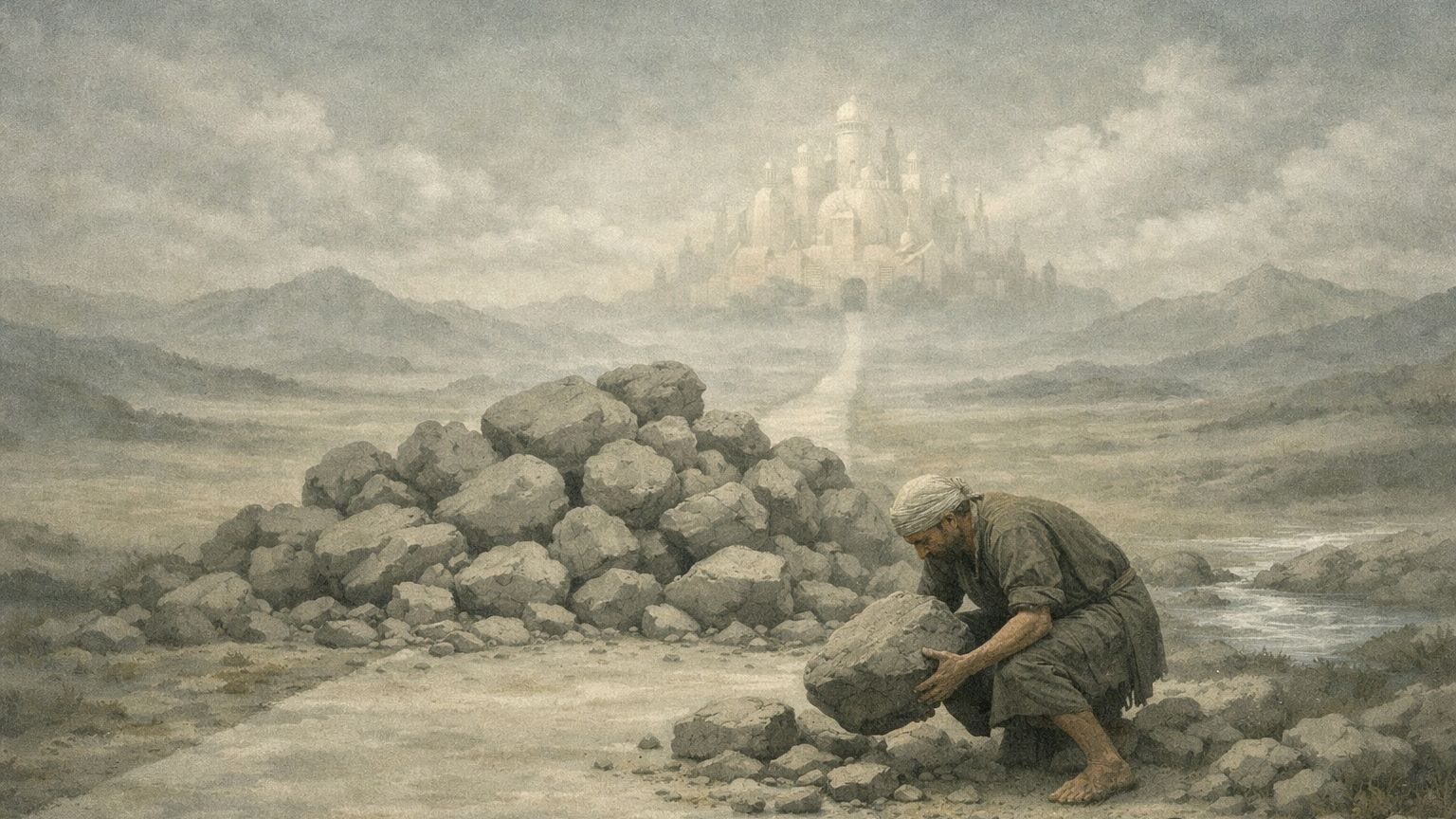
“Once, there was a wise king who built a straight road to his magnificent city. When it was finished, he proclaimed that whoever travelled his road best would be awarded a great prize.”
The Preacher’s stern face, like animated stone in the moonlight, emerged from the darkness. As sweat trickled down his brow, he looked to the multitude with impassioned eyes and said, “The king watched people from many lands gather, take their place at the road’s beginning, and ready themselves to best one another in the great race. Princes from afar, driving fine chariots drawn by powerful horses, stood alongside merchants made rich by silks and spices, whose camels had never been beaten in any desert race. The messengers of powerful generals, who could run many days without food or sleep, stretched their limbs and drank water as they prepared. The rich and the poor, the high and the low, the able and the lame—all hopeful of winning the great prize—stood side by side. For the wise king had built the road to aid people of all races, whether they walked with a straight back and head held high, or hobbled, hunched over a cripple’s crutch. And the only toll the wise king asked was that each traveller obey his laws.
“The wise king held high a white dove and, releasing it, began the contest to see who could travel his road best. Quickly did they move, both rich and poor, the beauty along the roadside a blur, the magnificence of the wise king’s lands unnoticed. One, however, interested not in the prize but desiring only a glimpse of the wise king’s fabled city, walked the straight road slowly, for he had no shoes on his feet and no supplies. Here and there the beggar took pause among fragrant flowers and listened to brightly coloured birds singing pleasing melodies. He ate sweet berries from bushes and drank water from the healing streams that blessed sunlit glades. And though all others were far in front, this poor man cared little, being happy with his full belly, quenched thirst, and joy-filled heart.”
Voice sinking in disbelief, the Preacher said, “But lo, when, after several days’ travel, the beggar’s happiness had become greater than it had ever been, a sadness overtook him, for he saw a huge pile of heavy rocks had fallen down a nearby hillside, blocking the straight road. He could tell the rocks had lain there many days, for makeshift bridges had been fashioned from the branches of nearby trees so those carried by chariots could ride over them more easily. Also, sandals fallen from those who had hastily clambered over the barrier were lodged here and there in the rocks. But none—none, I tell you—had stopped to undertake the task the beggar set himself. Alone, he began lifting each stone and rolling each boulder away so the straight, beautiful path would be clear for others to travel once more.
“When his labour was done, the day had grown late, and barely could the beggar see the last rock blocking the road. Yet on lifting it, he realised the heavy object was not a stone at all, but a bag filled with something that tinkled when shaken. And on opening the bag, what did the beggar find?” Eyes widening, voice tremulous, the Preacher cried, “Gold. Gold. Gold! Gold beyond anyone’s wildest dreams. Enough to build a palace, with servants bringing food and wine for evermore.
“To protect the gold from others, this penniless man slept curled around it. The next day, the road now clear, he continued, shouldering this weight until the sun went down. And again the next day, then during the days that followed, the beggar bore this burden until he reached the magnificent city of the wise king.”
The Preacher smiled and nodded solemnly, as if overwhelmed by the parable he told. “Once inside the city, brothers, sisters, what did the beggar do with all this wealth? Did he buy lavish robes, a fine meal, or a splendid chariot to carry him through the great city? Or even sandals to comfort his aching feet? Perhaps the beggar, intoxicated by wealth, went wild in his good fortune, gambling it away or paying those who would return favours with a smile? No, this poor man remained poor and walked barefoot up the many steps of the city’s magnificent palace to beg for an audience with the king. And on kneeling before the wise king, the beggar said, ‘Lord, along the road I found a pile of rocks, beneath which I found this fortune. Please, take it.’
“The king asked, ‘Why bring this gold to me, my son?’”
“‘So you may find its owner and return it to them,’” the beggar replied.
“The wise king smiled and looked kindly on the beggar as he said, ‘This bag of gold is the prize for the one who travelled my road best. This bag of gold belongs to you.’”
“‘But I was not the first to enter your city, Lord,’ the beggar said. ‘How can this great prize be mine? I did not travel your road best.’”
“And the wise king replied, ‘But you cleared the stones from the road so others may travel it more easily, my son. Those who travel my road best are those who make it easier for others to follow.’”
A heavy silence descended, dominating the darkness as the Preacher looked to those who listened and said, “Who among us would have walked around the rocks? Who among us has raced over them to enter the wise king’s magnificent city? And who among us would have lifted but a single pebble from the road so others may follow more easily? Who?” Shaking his head slowly, the Preacher lifted his hands before him and cried, “Not I. No, not I. Not a single stone did these hands lift as I raced towards salvation through our Lord.”
A tear fell down the Preacher’s cheek. Choked by shame, a few moments passed before he could again address the multitude. “Only… yes, only… when I became a beggar in spirit, brought low by my answered prayers… did I understand what our Lord desires of us all. Who here will help me clear his road… a road that has suffered the fall of so many rocks for so many years? Who here will give of themselves, though they be rich or poor, able or lame, high or low? Who here will help make the way easier for those who follow?”
As the Preacher stood, bathed in moonlight, tears glistened on his waxy cheeks. His words, choked with desperation, struggled to return as he said, “Who here will give with a prayer, that I might lift the first stone?”